

Artificial intelligence techniques that many would have considered science fiction only a few decades ago are now available to us in the twenty-first century. Regretfully, their performance is far from optimal; yet, this hasn't stopped avaricious individuals from establishing entire publishing companies driven by AI text.
After their entire family became ill after eating mushrooms that were mistaken in an AI-generated book, a netizen turned to the internet for guidance. Well, bored panda team members reached out to seasoned author Kristina God, who has written on AI writings before. They also sent a private message to the individual who shared the tale online, and they'll update the piece as soon as they respond.
It appears that writing whole novels with AI might not be possible.
AI is already widely used. Like any other tool, it is widely used and provides utility. When humans attempt to utilise AI improperly, it becomes an issue. A hammer is a practical instrument for driving a nail home. When it comes to window repairs, a hammer is not as helpful. It's helpful as long as you utilise the tool appropriately. Using AI to create an outline or anything simple to get you started might be a suitable usage.
But right now, I am being inundated with spam and artificial intelligence (AI)-generated books, blogs, and articles. AI can be seen as lazy human bait by writers.
But right now, I am being inundated with spam and artificial intelligence (AI)-generated books, blogs, and articles. AI can be seen as lazy human bait by writers.
For example, you might allow AI to produce a book in a few hours, either without or with minor changes, and then market it. However, the unpleasant reality is that using AI to write is difficult. To make it seem consistently human, effort will constantly need to be done: you'll need to invest hours learning how to trigger AI, perform extensive editing, incorporate a human touch, and verify the accuracy of the information. In essence, humans must perform the cognitive and creative tasks that AI is incapable of performing. Most individuals who give their stories to AI don't know how to modify them so they become truly outstanding narratives. And that's the main issue.
Therefore, I don't think AI will ever completely replace human authors. Reading books, articles, and poetry allows people to gain understanding of the human condition. AI is not currently able to deliver that. Furthermore, I would never pay to read anything created entirely by AI since I wouldn't find it to be worthwhile or distinctive enough. It is devoid of depth, originality, authority, and credibility.
Therefore, I predict that in the future, there will be a greater differentiation between paid and free material. Although most premium material—like the tales behind paywalls—will be created by people, the bulk of free content may be artificial intelligence (AI) produced, the speaker stated.
However, one family ended up in the hospital as a result of using an AI-generated mushroom identification book.
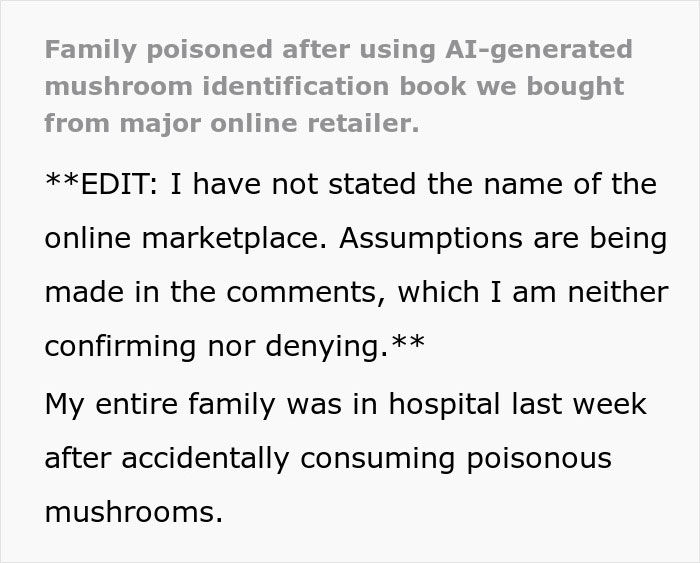
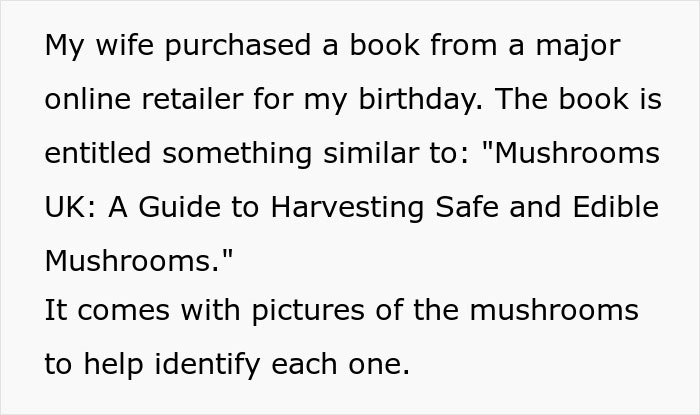
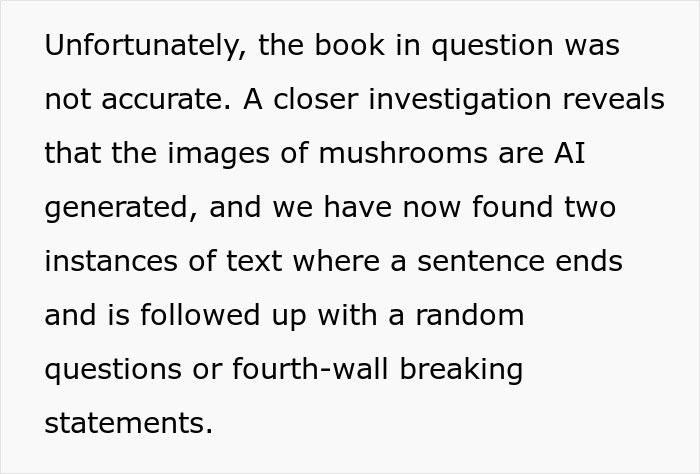
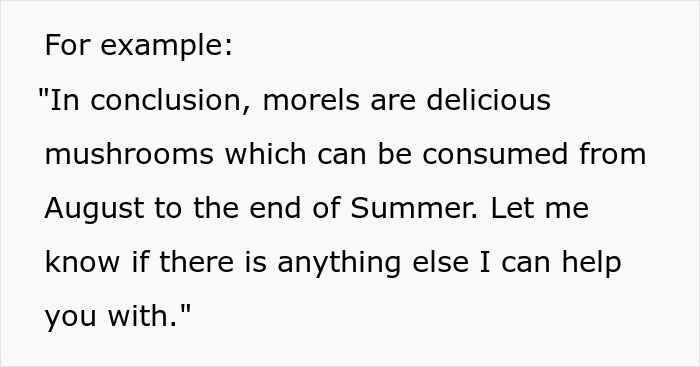
This book was probably written out of sloth and avarice.
This brings up the book on AI mushrooms. Sadly, I am unaware of the specifics because it would be irresponsible for anyone wishing to take legal action to publish all of the events online. I am not sure how that happened, but it was probably the result of some resourceful individual choosing to take several short cuts. They just requested a GPT tool to spit up a list of edible and inedible mushrooms rather than contacting an expert.
Maybe they even requested that it create the entire book. Nevertheless, this content was quickly thrown up and posted online without any human verification. The majority of AI programs will state clearly to the user that errors may and will be made by AI, hence it is crucial to double check information.
Maybe they even requested that it create the entire book. Nevertheless, this content was quickly thrown up and posted online without any human verification. The majority of AI programs will state clearly to the user that errors may and will be made by AI, hence it is crucial to double check information.
Recall that the hospitalised family made the correct decision when they really purchased a book to assist them in identifying mushrooms. The authors of the book would be held fully accountable if AI had not had a role in this situation. The claim that "a computer can never be held accountable, therefore must never make a management decision" was made in a 1979 IBM presentation. AI cannot serve as a "haven" where dishonest or lazy individuals may get away with defrauding others on the grounds that, "technically," they didn't author the book.